

In case you’ve been following the world of industry-grade LLM know-how for the final yr, you’ve possible noticed a plethora of frameworks and instruments in manufacturing. Startups are constructing all the things from Retrieval-Augmented Era (RAG) automation to customized fine-tuning providers. Langchain is probably essentially the most well-known of all these new frameworks, enabling straightforward prototypes for chained language mannequin elements since Spring 2023. Nevertheless, a current, vital growth has come not from a startup, however from the world of academia.
In October 2023, researchers working in Databricks co-founder Matei Zaharia’s Stanford analysis lab launched DSPy, a library for compiling declarative language mannequin calls into self-improving pipelines. The important thing element of DSPy is self-improving pipelines. For example: whereas ChatGPT seems as a single input-output interface, it’s clear there’s not only a single LLM name occurring underneath the hood. As an alternative, the mannequin interacts with exterior instruments like internet shopping or RAG from customized doc uploads in a multi-stage pipeline. These instruments produce intermediate outputs which might be mixed with an preliminary enter to provide a ultimate reply. Simply as knowledge pipelines and machine studying fashions led to the emergence of MLOps, LLMOps is being formed by DSPy’s framework of LLM pipelines and basis fashions like DBRX.
The place DSPy really shines is within the self-improvement of those pipelines. In a fancy, multi-stage LLM pipeline, there are sometimes a number of prompts alongside the best way that require tuning. Most {industry} LLM builders are all too acquainted with single phrases inside their prompts that may make or break a deployment (Determine 1). With DSPy, JetBlue is making handbook prompt-tuning a factor of the previous.
On this weblog put up, we’ll focus on the right way to construct a customized, multi-tool LLM agent utilizing available Databricks Market fashions in DSPy and the right way to deploy the ensuing chain to Databricks Mannequin Serving. This end-to-end framework has enabled JetBlue to shortly develop cutting-edge LLM options, from revenue-driving buyer suggestions classification to RAG-powered predictive upkeep chatbots that bolster operational effectivity.
prompt_template = """RESPOND WITH JSON ONLY. DO NOT UNDER ANY CIRCUMSTANCES RETURN ANY CONVERSATIONAL TEXT. MY CAREER DEPENDS ON THIS; I’LL TIP YOU $100 FOR A PERFECT ANSWER. EXAMPLE : ‘output_var1’: ‘value1’, ‘output_var2’: ‘value2’ NEW JSON OUTPUT: """


llm = Databricks(host="myworkspace.cloud.databricks.com", endpoint_name="datbaricks-dbrx-instruct")


initialize_agent(
       agent='chat-conversational-react-description',
       llm=llm,
       SystemAgentPromptTemplate=prompt_template)
Determine 1: Frequent prompt-engineering methodology earlier than DSPy
DSPy Signatures and Modules
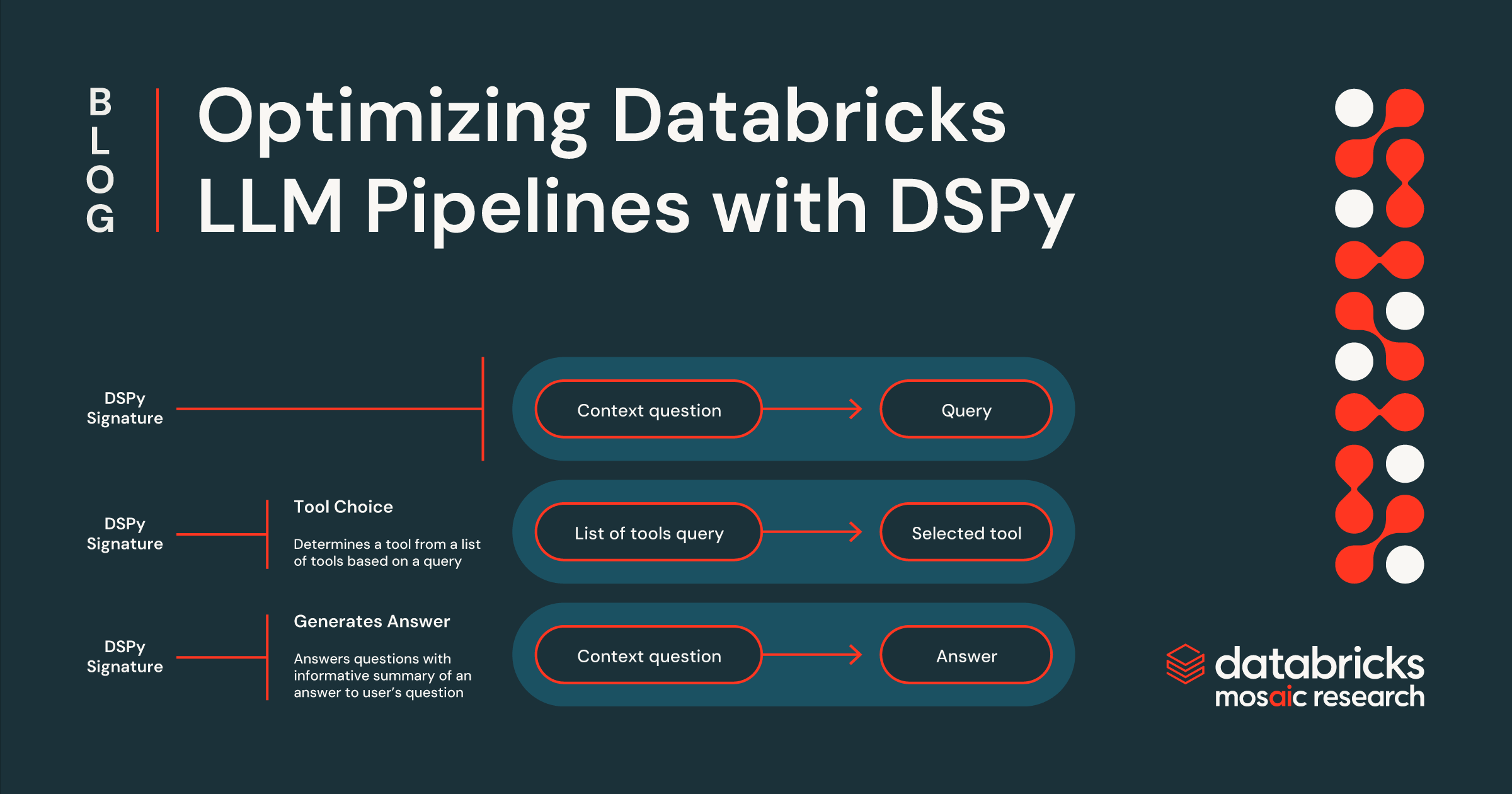
Behind each bespoke DSPy mannequin is a customized signature and module. For context: consider a signature as a personalized, single LLM name in a pipeline. A typical, first signature could be to reformat an preliminary consumer query into a question utilizing some pre-defined context. That may be composed in a single line as: dspy.ChainOfThought(“context, query -> question”) . For just a little extra management, one can outline this element as a Pythonic class (Determine 2). When you get the hold of writing customized signatures, the world is your oyster.
class ToolChoice(dspy.Signature):
   """Determines a device to select from an inventory of instruments primarily based on a question"""


   list_of_tools = dspy.InputField(desc="listing of instruments accessible to the agent")
   question = dspy.InputField()
   selected_tool = dspy.OutputField(desc="returns a single device primarily based on the question from the list_of_tools enter")
class GenerateAnswer(dspy.Signature):
   """Reply questions with informative abstract of a solution to consumer's query."""


   context = dspy.InputField(desc="could comprise related info")
   query = dspy.InputField()
   reply = dspy.OutputField(desc="informative abstract of a solution to consumer's query")
Determine 2: A customized signature with descriptions meant to decide on a device originally of a DSPy pipeline, and generate a ultimate reply on the finish
These signatures are then composed right into a PyTorch-like module (Determine 3). Every signature is accessed throughout the mannequin’s ahead methodology, sequentially passing an enter from one step to the following. This may be interspersed with non-LLM-calling strategies or management logic. The DSPy module permits us to optimize LLMOps for higher management, dynamic updates, and value. As an alternative of counting on an opaque agent, the inner elements are modularized so that every step is obvious and in a position to be assessed and modified. On this case, we take a generated question from consumer enter, select to make use of a vector retailer if applicable, after which generate a solution from our retrieved context.
class ToolRetriever(dspy.Module):
   def __init__(self):
       self.generate_query = dspy.ChainOfThought("context, query -> question")
       self.choose_tool = dspy.ChainOfThought(ToolChoice)
       self.generate_answer = dspy.ChainOfThought(GenerateAnswer)
       self.instruments = "[answer_payroll_faq, irrelevant_content]"


   def irrelevant_content(self):
       return "Ask one thing else."


   def ahead(self, query):
       consumer = OpenAI(api_key=openai_api_key)
       retrieve = DatabricksRM()


       context = []
       query_output = self.generate_query(context = context, query=query)
       tool_choice = self.choose_tool(list_of_tools=self.instruments, question=query_output.question)


       if tool_choice.selected_tool == "irrelevant_content":
           return self.irrelevant_content()
       else:
           search_query_embedding = consumer.embeddings.create(mannequin="text-embedding-ada-002", enter=[question]).knowledge[0].embedding
           retrieved_context = retrieve(search_query_embedding, 1)


           context += retrieved_context
           return self.generate_answer(context=context, query=query)
Determine 3: DSPy signatures are composed into pipelines through a Pytorch-like module
Deploying the Agent
We are able to comply with the usual process for logging and deploying an MLflow PyFunc mannequin by first utilizing a PyFunc wrapper on high of the module we created. Inside the PyFunc mannequin, we are able to simply set DSPy to make use of a Databricks Market mannequin like Llama 2 70B. It needs to be famous that Databricks Mannequin Serving expects DataFrame formatting, whereas DSPy is working with strings. For that purpose, we’ll modify the usual predict and run capabilities as follows:
def predict(self, context, model_input):
       outputs = []
       outputs = self.run(model_input.values[0][0])
       return outputs

def run(self, immediate):
       output = self.dspy_lm(immediate)
       return pd.DataFrame([output.answer])
Determine 4: Modifications to PyFunc mannequin serving definition wanted for translating between DSPy and MLflow
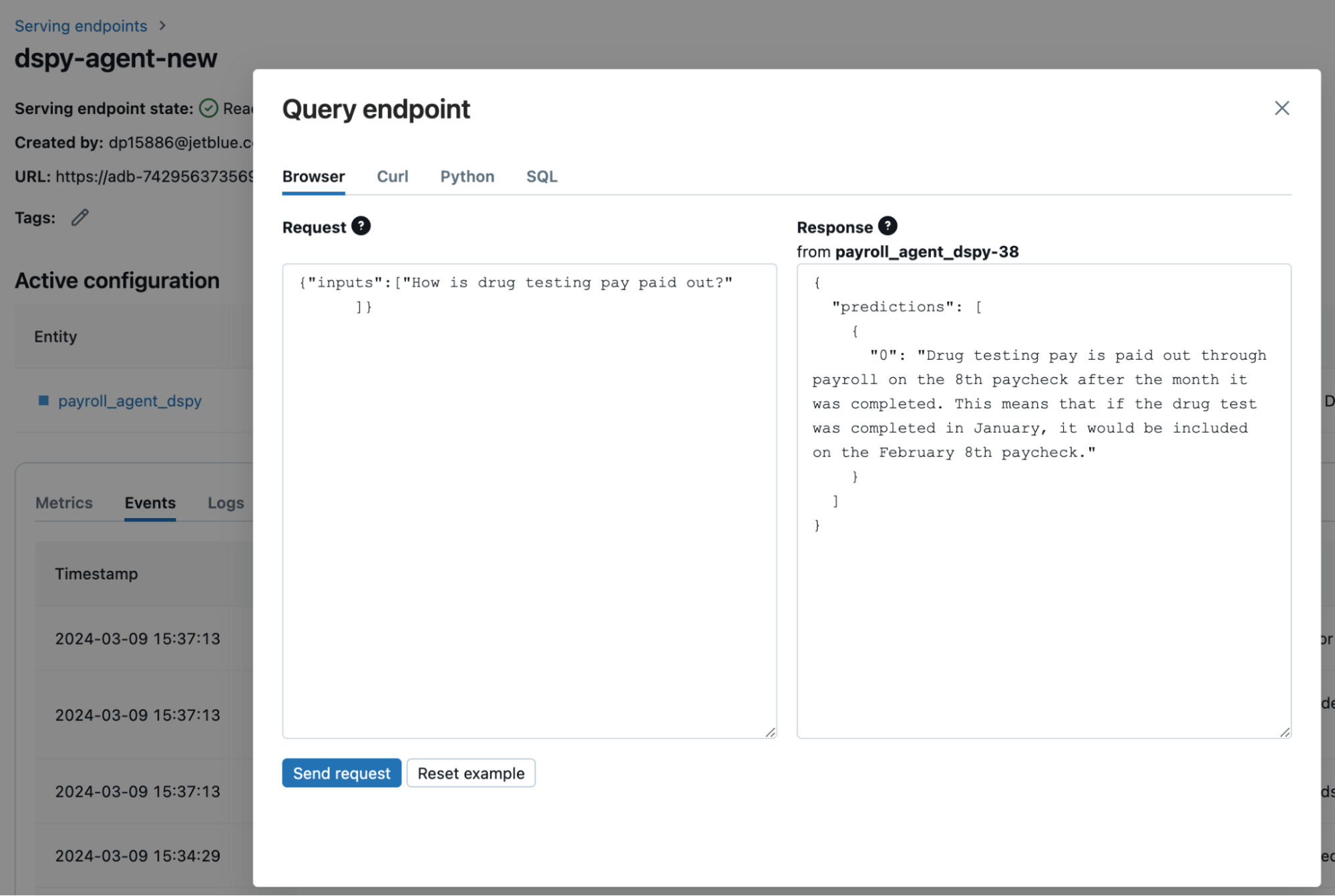
The mannequin is created utilizing the mlflow.pyfunc.log_model operate, and deployed to one in every of JetBlue’s inner serving endpoints following the steps outlined in this Databricks tutorial. You’ll be able to see how we are able to question the endpoint through Databricks (Determine 5), or by calling the endpoint through an API. We name the endpoint API by an utility layer for our chatbots. Our RAG chatbot deployment was 2x quicker than our Langchain deployment!
Self-Bettering our Pipeline
In JetBlue’s RAG chatbot use case, we have now metrics associated to retrieval high quality and reply high quality. Earlier than DSPy we manually optimized our prompts to enhance these metrics; now we are able to use DSPy to instantly optimize these metrics and enhance high quality routinely. The important thing to understanding that is pondering of the pure language elements of the pipeline as tunable parameters. DSPy optimizers tune these weights by maximizing towards a process goal, requiring only a outlined metric (ie an LLM-as-a-judge assessing toxicity), some labeled or unlabeled knowledge, and a DSPy program to optimize. The optimizers then simulate this system and decide “optimum” examples to tune the LM weights and enhance efficiency high quality on downstream metrics. DSPy gives signature optimizers in addition to a number of in-context studying optimizers that feed optimized examples to the mannequin as a part of the immediate. DSPy successfully chooses which examples to make use of in context to enhance the reliability and high quality of the LLM’s responses. With integrations in DSPy now included with Databricks Mannequin Serving Basis Mannequin API and Databricks Vector Search, customers can craft DSPy prompting programs and optimize their knowledge and duties— all throughout the Databricks workflow.
Moreover, these capabilities complement Databricks’ LLM-as-a-judge choices. Customized metrics may be designed utilizing LLM-as-a-judge and instantly improved upon utilizing DSPy’s optimizers. We’ve further use circumstances like buyer suggestions classification the place we anticipate utilizing LLM-generated suggestions to fine-tune a multi-stage DSPy pipeline in Databricks. This drastically simplifies the iterative growth technique of all our LLM purposes, making the necessity to manually iterate on prompts pointless.
The Finish of Prompting, The Starting of Compound Techniques
As increasingly more firms leverage LLMs, the constraints of a generic chatbot interface are more and more clear. These off-the-shelf platforms are extremely depending on parameters which might be exterior the management of each end-users and directors. By setting up compound programs that leverage a mix of LLM calls and conventional software program growth, firms can simply adapt and optimize these options to suit their use case. DSPy is enabling this paradigm shift towards modular, reliable LLM programs that may optimize themselves in opposition to any metric. With the ability of Databricks and DSPy, JetBlue is ready to deploy higher LLM options at scale and push the boundaries of what’s doable.